

In light of the latest studies that prove social media can damage the self-image of teens and tweens, I have a confession to make: my husband has never seen my high school senior picture. I hated that picture. I thought my face looked like Humpty Dumpty.
So, I vowed to lose weight. And I did. By the time I started my first year in college, I had lost 30 pounds.
What teenage girl hasn’t agonized over every aspect of her appearance? Sadly, some women in their 40s, 50s, and even 60s are still agonizing.
Let’s be candid. As a woman in our culture, being “beautiful and thin” is more important than intelligence, modesty, or any virtue the Bible talks about.
Our Obsession with Beauty
Beauty is big business in our culture. The global beauty industry, valued at approximately $450 billion, targets significant marketing resources toward women, who drive over 70% of total consumer spending in this sector. For teens, constant photo-sharing (selfies) encourages girls to view themselves as objects to be evaluated by others, a process called self-objectification, which heightens appearance anxiety. According to Frederickson and Roberts in their foundational Objectification Theory (https://journals.sagepub.com/doi/10.1111/j.1471-6402.1997.tb00108.x):
“Self-objectification is the process by which individuals (most commonly women and girls) internalize an external observer’s perspective on their own bodies, treating or viewing themselves primarily as objects to be looked at, evaluated, and used based on their appearance rather than as whole persons with agency, feelings, or capabilities. This often involves habitual body monitoring (self-surveillance), valuing appearance over function, and can lead to negative outcomes like body shame, appearance anxiety, disrupted focus, and increased risks for issues such as eating disorders, depression, and reduced interoceptive awareness.”
How Beauty Addiction Harms
After my psychotic break, I reverted to how I behaved my first year in college. Because I felt shattered into a thousand pieces, I obsessively monitored my weight and my calorie intake. People on antipsychotics often gain weight rapidly. National Health and Nutrition Examination Surveys (https://www.cdc.gov/nchs/products/databriefs/db167.htm) show:
“Forty-three percent of adults with depression were obese, and adults with depression were more likely to be obese than adults without depression. In every age group, women with depression were more likely to be obese than women without depression.”
In 2016, I was exercising on the rowing machine six days a week, counting my calories in Excel, and weighing myself daily. I would spend at least two hours a day getting ready before I left the house. I would evaluate myself each day based on how well I kept to my ideal of 1,800 calories a day. Telling my psychiatrist about my daily routine, she said, “You have an inactive eating disorder.”
At the time, I didn’t understand what she meant. But I was not alone in my difficulties with food. An estimated 20 million American women will have an eating disorder at some point in their lives.
Unfortunately, being obsessed with exercise and being on a sodium-depleting medication combined to land me in the ICU for five days with life-threateningly low levels of sodium. Attempts to correct this by changing my bipolar medications led to a psychotic episode immediately after release from the ICU, and I missed my son’s high school graduation after being hospitalized for the psychosis.
All of us are, in some way, fragile. With mental illness, there are no guarantees. You can be “on top of the world,” but then your body will betray you.
NAMI Can Help
This time when I was hospitalized, I knew what the recovery process would look like. Classes from the National Alliance on Mental Illness (NAMI) had equipped me with tools both to understand the process and to walk through the hospitalization and aftermath.
NAMI helped me know that at first, I would need support, comfort, empathy, crisis management, and hope during this confusing time. Dealing with a brain disease means dealing with a whole host of emotions: denial, anger, bargaining, depression, and finally acceptance. As you will see in NAMI classes, learning to cope isn’t linear. Acceptance of an illness is difficult regardless of where it is located in your body. Finding a safe place to vent your frustrations with the behavioral health system, learning what self-care means, and learning the ins and outs of the system are all vital components in recovery. Through the NAMI support groups and classes, participants can get ideas from each other on how to cope. NAMI calls this group wisdom.
The final stage of the process is moving to advocacy. Through group wisdom, you learn to navigate the system, your own body, and the pathway to hope. Having someone to walk alongside you on your journey helps. I know from personal experience what a difference it makes if your family and friends have been through the NAMI programs.
Accepting Ourselves
The Bible tells us we are “fearfully and wonderfully made”. God knit together each of us in our mother’s womb. You and I are God’s masterpieces in all of creation.
I realize now that being out in nature on my front porch restores my soul and inspires my own creativity. God reminds us through the birds of the field that He is the one who provides. He also makes all things beautiful in his time. Have you ever looked closely at a hummingbird? They are gorgeous.
Nature inspires my own creativity to draw what I see in the natural world. Creating my own art finally freed me from treating my body like my only canvas. Through my needlework, I find hours of endless joy in attempting to replicate on denim what I see in the nature world. My love, joy, and pride in what I create echoes God’s love, joy, and pride in me.
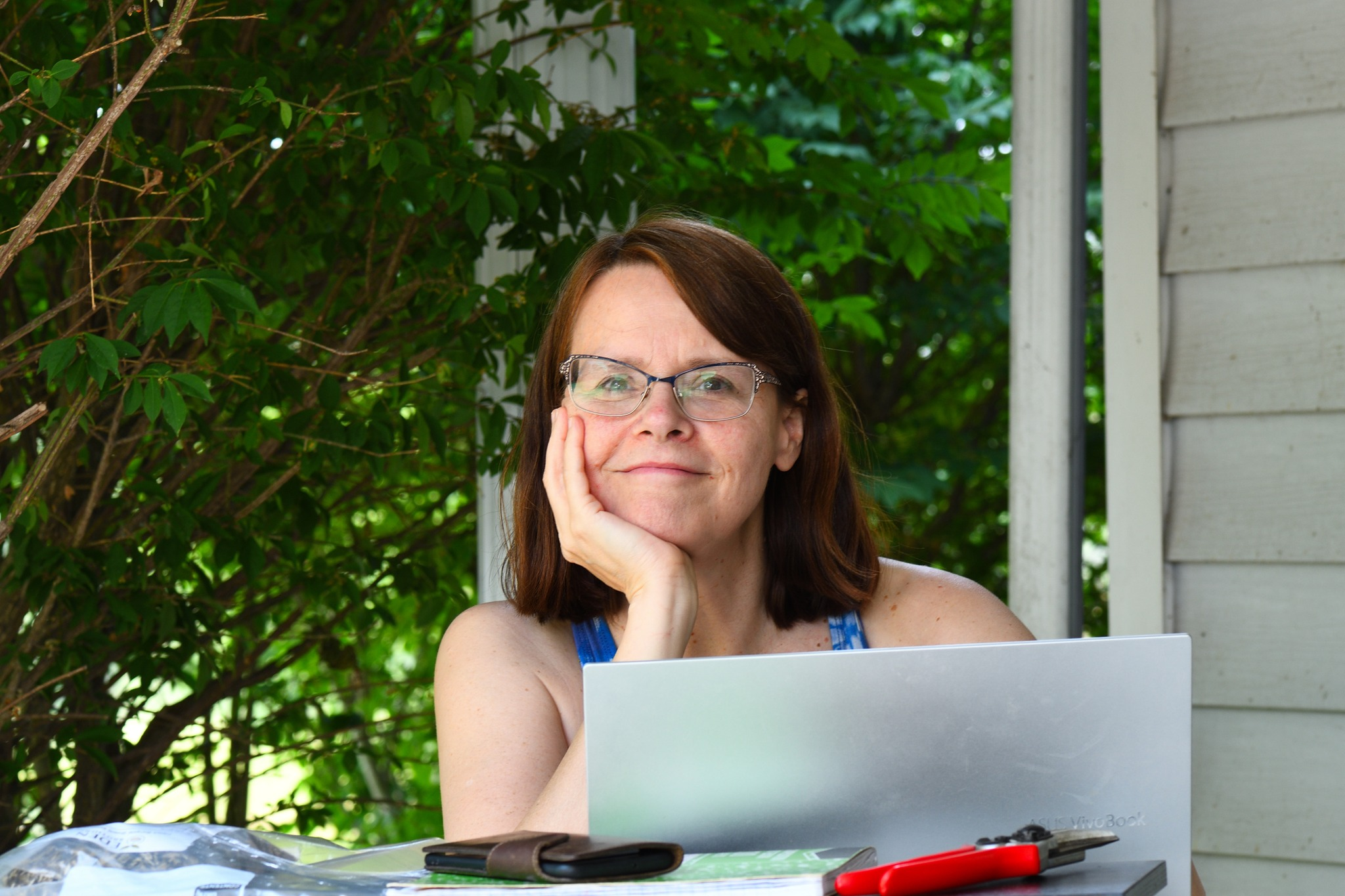
I will always remember the day, when I started calling myself “artist in residence” here at Edelen Acres. My husband, Dan, snapped a picture of me without makeup sitting out on our front porch. For the first time I didn’t panic because I didn’t have on makeup. Looking at the picture I thought, I look how I feel—happy and content. Others are beginning to catch on to this freedom. Pamela Anderson and other actresses have joined the cause of accepting oneself as well.
As a mature woman, my body will never look like a young, nubile woman anymore. When asked, my husband said I look marvelous. I don’t need the affirmation of every man. One husband is all I need.
I don’t need to outdo other women in beauty either. In the end, that’s a competition no one wins. If, by sharing my lived experience, I can help one woman learn to accept herself and her body as God designed her to be, I have done my job today.
“Beauty is in the eye of the beholder,” — Margaret Wolfe Hungerford
 Mental Health Warrior