
Imagine that your home was struck by a tornado and collapsed into the basement. How does a person recover from such a catastrophe?
Anyone who has endured a mental illness diagnosis doesn’t just feel like their house has been broken into a million pieces. They feel one with the house itself, like they are in pieces too.
When my psychologist explained this metaphor to me, it all made sense. All my emotions and feelings after my psychotic break and bipolar diagnosis finally had an image that described how I felt. I sat in a pit filled with what had been me, had been my life, but now it was just so much debris. I was confused, having difficulty focusing; I felt overwhelmed, vulnerable, and afraid.
If you’ve been a patient with a mental illness diagnosis, or you know someone who has walked that road, you understand.
Having people in your life who stay true to you even when you feel like a worthless pile of broken bits helps with recovery. While some people may say, “I’ll be praying for you! Call me if you need anything!” they may never understand what you are going through.
Then there are the rare people who can truly stand beside you amid the shattered pieces of your “house.” These people get it.
I remember endless days of feeling so lonely that my bones ached—what little was left of my foundation crumbling beneath me. Luckily, I was able to connect with an old friend from college. Over the next few months, he was there for me. My Good Samaritan said to me:
“You have a condition that presents immense challenges and struggles, but it also makes you special. Genius, enlightenment, and extraordinary insight never come to ‘normal’ people; that level of emotional and spiritual breakthrough only comes to the tormented in spirit. This does not diminish you. It does not make you less my friend or less God’s child or less close to divinity. It makes you more of each of those things.”
For some of us, we must hit “rock bottom” emotionally before we can see ourselves through God’s eyes, to view ourselves as He sees us. Thanks to my friend’s encouragement and my psychologist’s insights, I realized that I had been viewing myself through the eyes of this world, succumbing to the stigma many people attach to mental illness.
If this resonates with you, with where you are, understand that you are not your illness. Your house may have collapsed, but your life is not over, and others are there to help you rebuild.
It’s not just outsiders who can help you rebuild. Often, you are the one who discovers a way to rebuild yourself.
During COVID, art became my therapy
In late 2019, I was doing better because of a reduction in medication, taking an art class, and doing some volunteer work. Then COVID-19 hit in early 2020. Like everyone I was in shock. Many of my supports got kicked out from under me again, including the class and volunteering.
But while the art class was forced to go virtual, it kept going. My teacher assigned a virtual project to create a drawing every day for 20 days. My first assignment? Draw my eye. I decided to post it on Facebook. What happened? People responded with likes, comments, and even a share. Suddenly, amid this scary COVID situation, these compliments from my family and friends provided a daily focus and purpose.
Let me be clear, I am not a trained professional. Drawing each object represented its own unique challenge. All I had were my supplies from class: my charcoal sticks, colored pencils, and drawing journal. Yet I was learning. Each day, I would work on my assignment, despair at least once that I should give up, finish the drawing, and then post it on Facebook. More people started responding and commenting, some I had not heard from in years.
Not every drawing was a winner—you should have seen my fat cat. But comments like “Love your drawings; they enliven my day,” kept me going one day at a time.
I am convinced that drawing daily and overcoming each little challenge helped rewire my brain in a positive way. All the support I received online helped rebuild my confidence as well.
What is a hobby, task, or challenge you can take up that can help you build confidence after a mental illness diagnosis? What skill have you neglected but have always wanted to revisit? Maybe now is the time.
Was drawing every day a cure? No. Every day I wrestle with my mental illness. But it was one helpful step out of the pit and toward rebuilding the house that is me.
How needlework was born
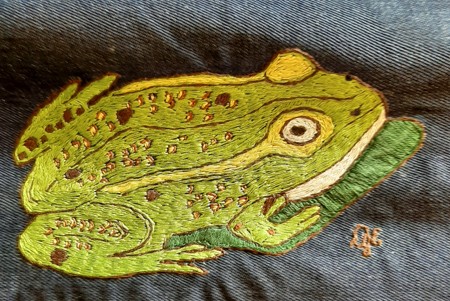
About a year or so ago, I started doing embroidery kits, but I didn’t like them. So, I invented my own stitches and started creating my own needlework designs instead. I began with drawings I created during COVID. Working on my needlework brings me joy. I love everything about the process.
An admirer of my needlework creations said it best:
“I have a theory that the fiber arts are soothing psychologically. There is something calming about that thread or yarn sliding through your fingers, each step a tiny goal accomplished! When we can’t solve all of life’s problems, that small accomplishment of completing a stitch and beautifully filling a blank canvas gives us a great substitute. When it’s done, you have a beautiful, satisfying work you can look upon with joy and a sense of fulfillment.”
Now, working with my hands through needlework brings a sense of flow, keeping me centered, focused, and “into” my fiber art. Research into this idea of “flow” confirms what creatives around the world have learned through firsthand experience: the flow state can bring improved health, creativity, and emotional well-being. As Laurie Smith, the author of The Flow Habit notes, results show that those who engaged in creative pursuits during the early stages of the pandemic “reported higher levels of self-esteem, optimism, and positive affect. In contrast, those who pursued fewer creative outlets had higher levels of depression and anxiety, were higher in boredom proneness, and reported experiencing more negative effects.”
It’s incredible to know that once your life felt irreparably broken and awful, like a house destroyed by a tornado, but despite all that destruction beauty can come out of it and you can find the flow of your life again. Supportive friends, family, and a point of focus such as art can go a long way toward rebuilding the metaphorical house each of us inhabits.
“The purpose of art is washing the dust of daily life off our souls.” – Pablo Picasso
 Mental Health Warrior